
Reading map

Three safe starting points for technical study

These notes are written as a conservative orientation layer rather than a lab manual. They explain what common terms mean, how ideas fit together, and where a learner can move next. They do not include operational protocols, hazardous procedures, medical claims, or instrument-specific service instructions.

Abstract molecular vibration and spectroscopy illustration

Physical chemistry

Quantum mechanics and two-dimensional infrared spectroscopy

Quantum mechanics describes microscopic systems using states, operators, and probabilities. Instead of assigning a particle a single classical path, it represents available outcomes with a wavefunction or state vector. A measurement extracts an observable, such as energy or momentum, and the theory predicts a distribution of possible results rather than a deterministic trajectory.

In molecular spectroscopy this framework becomes concrete. Bonds stretch, bend, and rotate through quantized vibrational and rotational modes. Infrared light can exchange energy with a molecule when the light frequency matches an allowed transition and the motion changes the molecular dipole. Peaks in an infrared spectrum are therefore not arbitrary marks: they summarize the allowed motions of a molecule and the environment that perturbs those motions.

Two-dimensional infrared spectroscopy, often written as 2D IR, extends this idea by using sequences of ultrafast infrared pulses. The resulting map has two frequency axes. Diagonal features show modes that absorb and emit at related frequencies, while off-diagonal cross peaks can reveal coupling, energy transfer, or shared structural environments. The time delay between pulses adds a controlled way to watch molecular dynamics unfold.

Scope: the discussion here stays at the level of concepts and interpretation. It avoids procedural laser alignment, sample-handling recipes, and instrument-specific operating steps.
  • Key terms: state, observable, transition, vibrational mode.
  • Useful bridge: connect this section with mass spectrometry by comparing spectra as indirect evidence.
  • Computing link: use Python basics to load tabular peak data and plot simple trends.
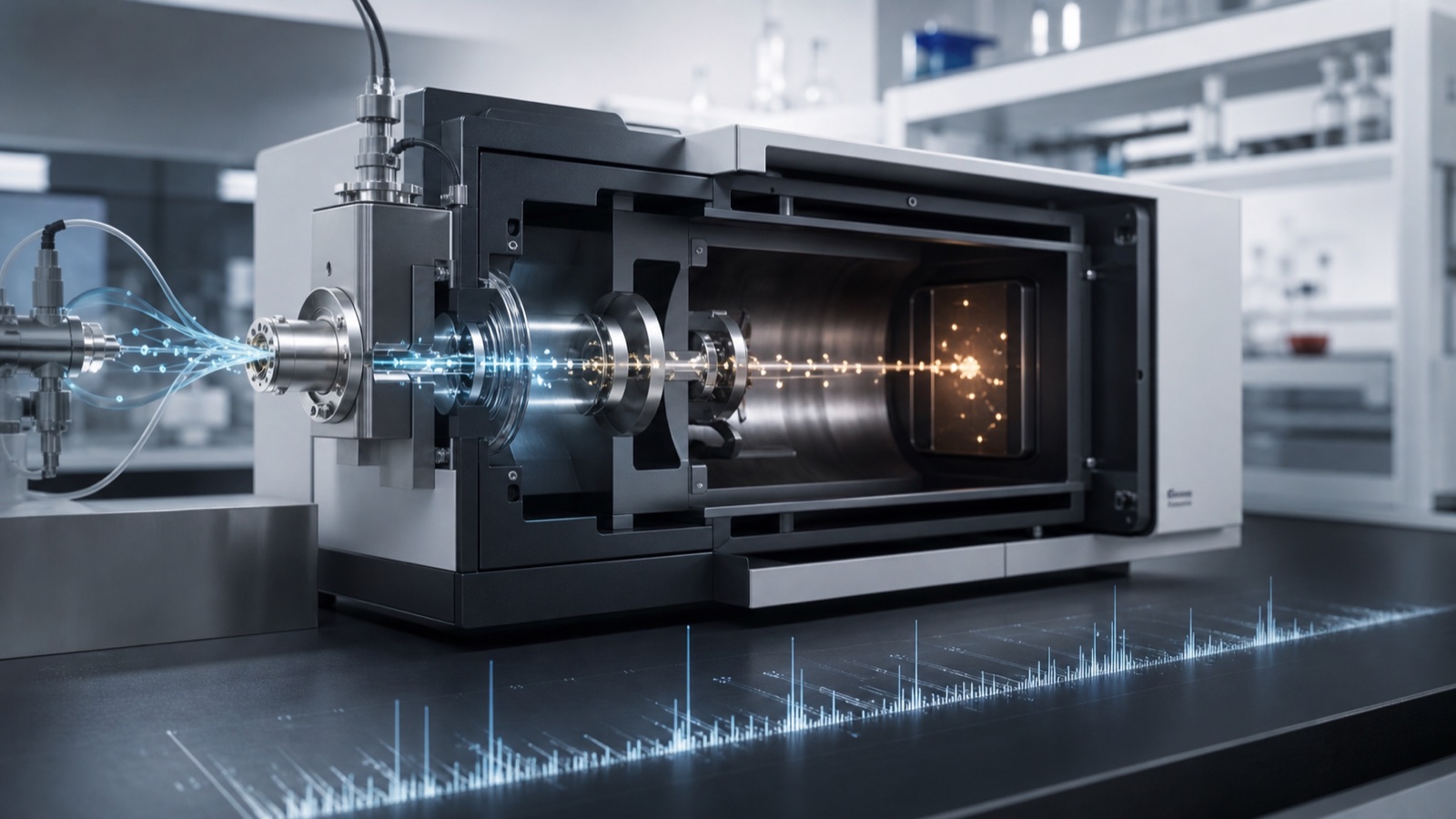
Mass spectrometry instrument and ion path illustration

Analytical chemistry

Mass spectrometry: from ions to interpretable peaks

Mass spectrometry measures ions according to their mass-to-charge ratio, commonly written as m/z. A neutral molecule is first converted into one or more ions. Those ions move through electric or magnetic fields, separate according to m/z, and reach a detector that records their relative abundance. The output is a spectrum: a set of peaks whose positions and intensities carry chemical information.

The core idea is simple, but interpretation requires restraint. A peak may represent a molecular ion, a fragment, an isotope pattern, an adduct, or a background signal. Analysts compare the observed pattern with expected elemental composition, ionization behavior, instrument resolution, calibration status, and sample context. Good interpretation is convergent: several independent clues should point toward the same explanation.

Different instruments emphasize different tradeoffs. Quadrupoles are robust for filtering selected m/z values. Time-of-flight systems use flight time as a proxy for m/z and can support high acquisition rates. Orbitrap and ion-trap approaches can provide high resolving power or staged fragmentation. The right mental model is not one universal machine, but a family of measurement strategies.

Safe reading rule: use these notes for terminology and interpretation. They are not instructions for building, servicing, modifying, or operating analytical hardware.
  • Key terms: ionization, m/z, detector, isotope pattern, resolution.
  • Comparison point: unlike 2D IR, mass spectrometry observes charged species after ionization.
  • Computing link: a small Python script can normalize intensities and annotate peaks reproducibly.
Quiet desktop with abstract programming and data visuals

Computing

Python basics for reproducible technical work

Python is useful for technical learning because it stays readable while supporting real data work. The fundamentals are small: variables bind names to values, data types describe what operations make sense, control flow chooses which statements run, and functions package repeated logic. A careful beginner can do meaningful work with lists, dictionaries, loops, conditionals, and a few standard library modules.

Reliable scripts are built from boring habits. Use descriptive names, keep inputs and outputs explicit, separate calculation from plotting, and check intermediate shapes or counts before trusting a result. For numerical work, convergence means that an answer does not depend wildly on a tolerance, a step size, or a hidden ordering assumption. Small checks make the script safer than a clever one-off notebook cell.

A simple learning path is to read a CSV file, clean column names, compute a few summary values, and draw a chart. The same pattern can support spectroscopy or mass spectrometry notes: import data, validate units, transform values in clearly named steps, and save the result. The goal is not to memorize syntax; it is to make a repeatable chain from question to evidence.

Practical boundary: the examples implied here are local, educational, and non-destructive. They avoid credentials, network scanning, automation against third-party systems, and environment-specific secrets.
  • Key terms: type, loop, function, exception, file path, module.
  • Good first task: parse a small table and print validated summary statistics.
  • Study link: use code to compare examples from 2D IR and mass spectrometry.